Expressvpn Glossary
Quantum cryptography

What is quantum cryptography?
Quantum cryptography is a security method that uses quantum particles to generate and protect encryption keys. It relies on the physical behavior of light to detect whether a communication channel has been exposed or altered.
How does quantum cryptography work?
Quantum cryptography works by using quantum particles, usually photons, to create a shared encryption key between two parties. Each photon is prepared in a specific quantum state that represents part of the key. Because quantum states change when they’re observed, any attempt to observe or copy the information photos carry leaves a detectable trace.
To make this possible, quantum cryptography relies on quantum key distribution (QKD), a family of protocols that send these photons and check whether their states were disturbed. The sender and receiver compare parts of their measurements over a normal communication channel, and if the photons behaved as expected, they know the key was transmitted privately.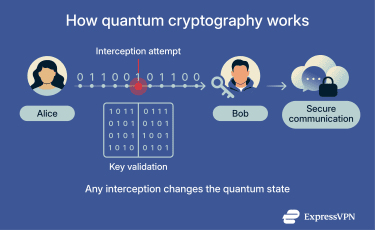
Key components of quantum cryptography
- Quantum bits (qubits): Quantum units of information that can hold multiple states at once, forming the basis of quantum encryption and quantum communication.
- Photon transmission: The process of sending photons through a quantum channel, where their fragile quantum states make eavesdropping detectable.
- QKD: A method for establishing a shared key by transmitting quantum states and checking them for signs of interference during the exchange.
- Classical channel: A conventional communication path used to compare measurement results, correct errors, and confirm that the quantum key was transmitted securely.
Quantum cryptography vs. classical cryptography
| Feature | Quantum cryptography | Classical cryptography |
| Basis | Physics (quantum mechanics) | Mathematics (algorithms) |
| Security guarantee | Intrusion detectable | Intrusion may be undetectable |
| Key distribution | QKD | Digital key exchange |
| Vulnerability to quantum computers | Resistant | Potentially vulnerable |
| Implementation | Specialized hardware | Software-based |
Why is quantum cryptography important?
Quantum cryptography is important because it offers a way to detect eavesdropping during the creation of encryption keys, which is something classical cryptographic methods can’t do. By using the behavior of quantum particles, it ensures that any interception attempt leaves a visible trace, allowing the parties to discard compromised keys and keep only keys that were transmitted securely.
This makes quantum cryptography especially valuable for protecting highly sensitive information and for building communication systems that remain secure even as advances in computing challenge traditional encryption.
Security and privacy considerations
Quantum cryptography adds strong protections during key exchange, but it doesn’t eliminate the need for strong security across the rest of a communication system. Quantum components often require specialized hardware and tightly controlled environments to operate reliably, which limits where they can be deployed today. Even when quantum methods are used, the data itself still travels over classical networks, meaning traditional encryption and secure tunneling remain essential.
Common applications
Quantum cryptography is being explored in several fields where secure key exchange and tamper detection are especially valuable, including:
- Government and defense: Used to secure high-integrity communications where tamper detection is critical.
- Financial systems: Protects sensitive transaction channels that require strong, verified key exchange.
- Healthcare environments: Safeguards patient information shared across networks that must meet strict privacy standards.
Further reading
- Quantum cryptography: A detailed guide
- What is cryptography?
- What is lattice-based cryptography?
- The history of encryption: From ancient codes to digital security
 Support Center
  FAQ
FAQ  VPN Setup Tutorials